---
title: "Instrumental variables"
---
```{r setup, include=FALSE}
knitr::opts_chunk$set(fig.width = 6, fig.asp = 0.618, fig.align = "center",
fig.retina = 3, out.width = "75%", collapse = TRUE)
set.seed(1234)
options("digits" = 2, "width" = 150)
options(dplyr.summarise.inform = FALSE)
options("modelsummary_factory_default" = "tinytable")
options(marginaleffects_print_style = "data.frame")
```
## Video walk-through
If you want to follow along with this example, you can download these three datasets:
- [{{< fa table >}} `father_education.csv`](/files/data/generated_data/father_education.csv)
- [{{< fa table >}} `wage2.csv`](/files/data/package_data/wage2.csv)
- [{{< fa table >}} `card.csv`](/files/data/package_data/card.csv)
```{r show-youtube-list, echo=FALSE, results="asis"}
source(here::here("R", "youtube-playlist.R"))
playlist_id <- "PLS6tnpTr39sF97TfofFZ1O-bOQtB4ygZQ"
video_details <- tibble::tribble(
~youtube_id, ~title,
"h-rx-dXo74Y", "Getting started",
"wHTiAbGwKe4", "Checking instrument validity",
"tnerIh0uMxU", "Manual 2SLS",
"EI-knWTbH-s", "One-step 2SLS",
"W8Up5OOPtEY", "Checking instrument validity (real data)",
"6sp8sYrRv5c", "2SLS (real data)",
"uDr4nsWkG2c", "Validity + 2SLS (real data)"
)
youtube_list(video_details, playlist_id, example = TRUE)
```
## Background
For all these examples, we're interested in the perennial econometrics question of whether an extra year of education causes increased wages. Economists love this stuff.
We'll explore the question with three different datasets: a fake one I made up and two real ones from published research.
- [{{< fa table >}} `father_education.csv`](/files/data/generated_data/father_education.csv)
- [{{< fa table >}} `wage2.csv`](/files/data/package_data/wage2.csv)
- [{{< fa table >}} `card.csv`](/files/data/package_data/card.csv)
Make sure you load all these libraries before getting started:
```{r load-libraries, message=FALSE, warning=FALSE}
library(tidyverse)  # ggplot(), mutate(), and friends
library(parameters)  # Extract model parameters to data frames
library(performance) # Extract model details to data frames
library(marginaleffects) # Easier model predictions
library(modelsummary)  # Create side-by-side regression tables
library(tinytable)  # Add fancier formatting to tables
library(estimatr)  # Run 2SLS models in one step with iv_robust()
```
## Education, wages, and father's education (fake data)
First let's use some fake data to see if education causes additional wages.
```{.r}
ed_fake <- read_csv("data/father_education.csv")
```
```{r load-fake-data-real, include=FALSE}
ed_fake <- read_csv(here::here("files", "data", "generated_data", "father_education.csv"))
```
The `father_education.csv` file contains four variables:
| Variable name | Description |
| ------------- | ------------------------------------------------------------------------------------- |
| `wage` | Weekly wage |
| `educ` | Years of education |
| `ability` | Magical column that measures your ability to work and go to school (omitted variable) |
| `fathereduc` | Years of education for father |
### Naive model
If we could actually measure ability, we could estimate this model, which closes the confounding backdoor posed by ability and isolates just the effect of education on wages:
```{r}
model_forbidden <- lm(wage ~ educ + ability, data = ed_fake)
model_parameters(model_forbidden)
```
However, in real life we don't have `ability`, so we're stuck with a naive model:
```{r}
model_naive <- lm(wage ~ educ, data = ed_fake)
model_parameters(model_naive)
```
The naive model overestimates the effect of education on wages (12.2 vs. 9.24) because of omitted variable bias. Education suffers from endogeneity---there are things in the model (like ability, hidden in the error term) that are correlated with it. Any estimate we calculate will be wrong and biased because of selection effects or omitted variable bias (all different names for endogeneity).
### Check instrument validity
To fix the endogeneity problem, we can use an instrument to remove the endogeneity from education and instead use a special exogeneity-only version of education. Perhaps someone's father's education can be an instrument for education (it's not the greatest instrument, but we'll go with it).
For an instrument to be valid, it must meet three criteria:
1. **Relevance**: Instrument is correlated with policy variable
2. **Exclusion**: Instrument is correlated with outcome *only through* the policy variable
3. **Exogeneity**: Instrument isn't correlated with anything else in the model (i.e. omitted variables)
**Relevance**
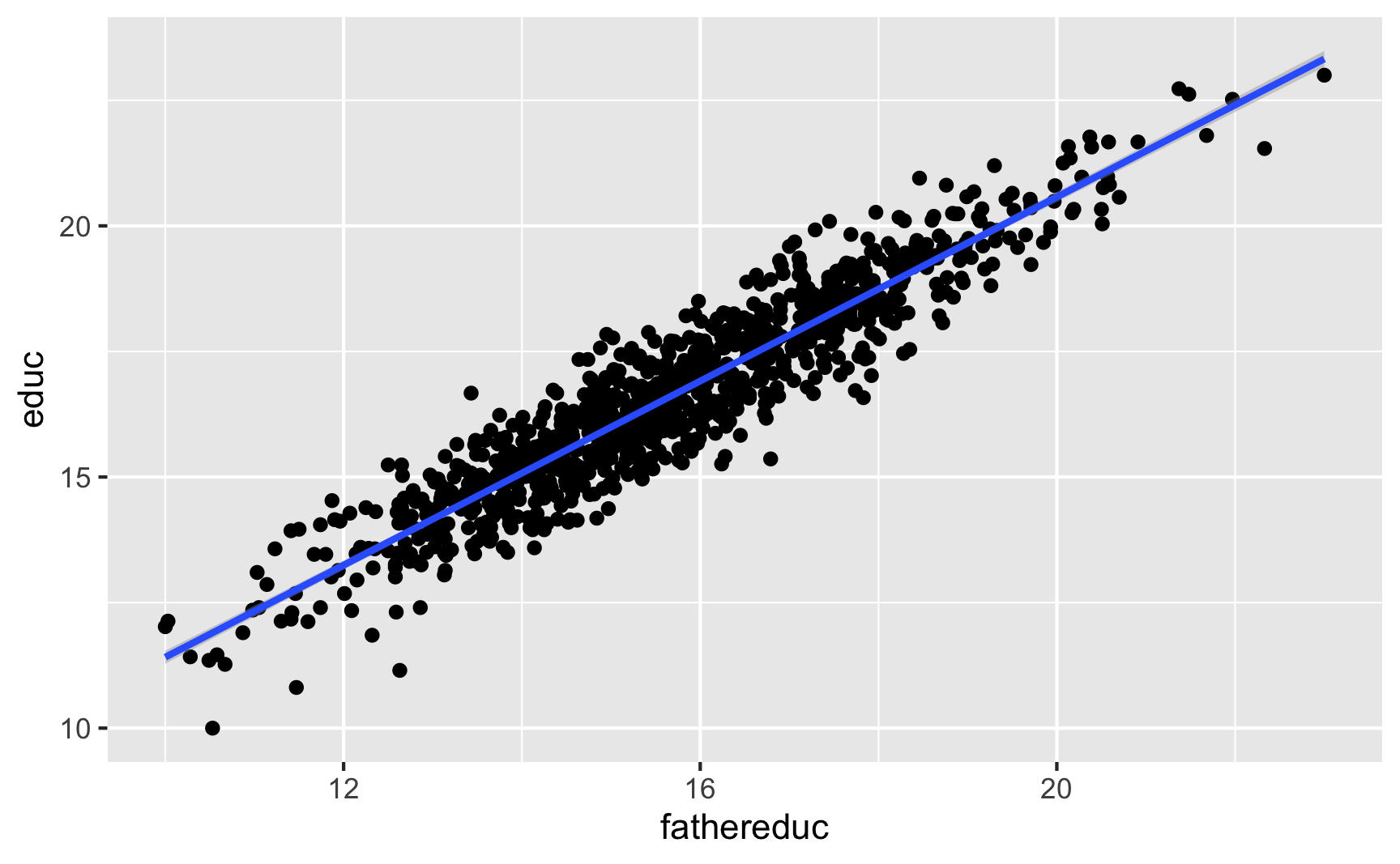
We can first test relevance by making a scatterplot and running a model of `policy ~ instrument`:
```{r message=FALSE}
ggplot(ed_fake, aes(x = fathereduc, y = educ)) +
  geom_point() +
  geom_smooth(method = "lm")
check_relevance <- lm(educ ~ fathereduc, data = ed_fake)
model_parameters(check_relevance)
modelsummary::get_gof(check_relevance)
```
This looks pretty good! The F-statistic is definitely above 10 (it's 7,136!), and there's a significant relationship between the instrument and policy. I'd say that this is relevant.
**Exclusion**
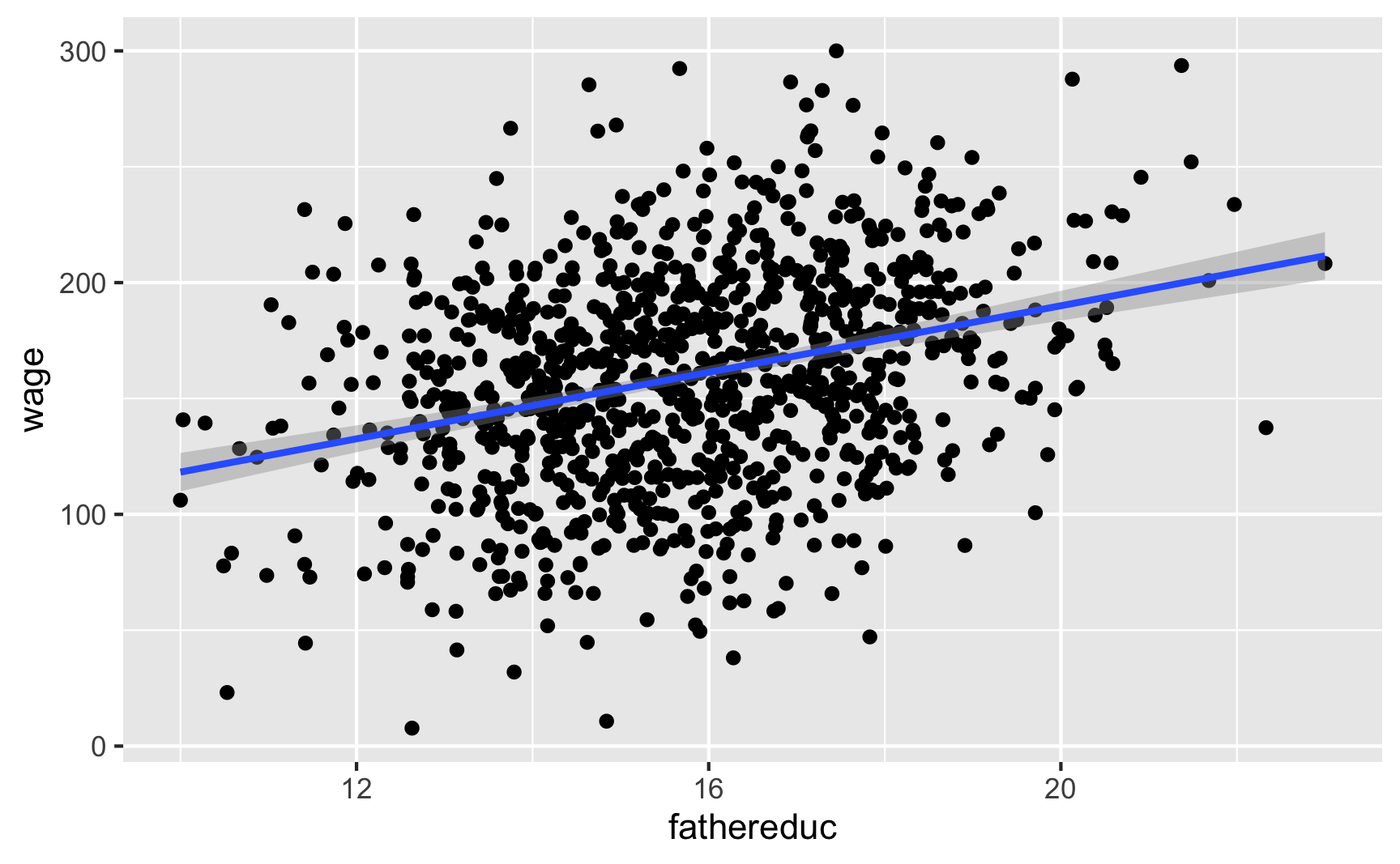
To check for exclusion, we need to see if there's a relationship between father's education and wages that occurs *only* because of education. If we plot it, we'll see a relationship:
```{r message=FALSE}
ggplot(ed_fake, aes(x = fathereduc, y = wage)) +
  geom_point() +
  geom_smooth(method = "lm")
```
That's to be expected, since in our model, father's education causes education which causes wages---they should be correlated. But we have to use a convincing story + theory to justify the idea that a father's education increases the hourly wage *only because it increases one's education*, and there's no real statistical test for that. Good luck.
**Exogeneity**
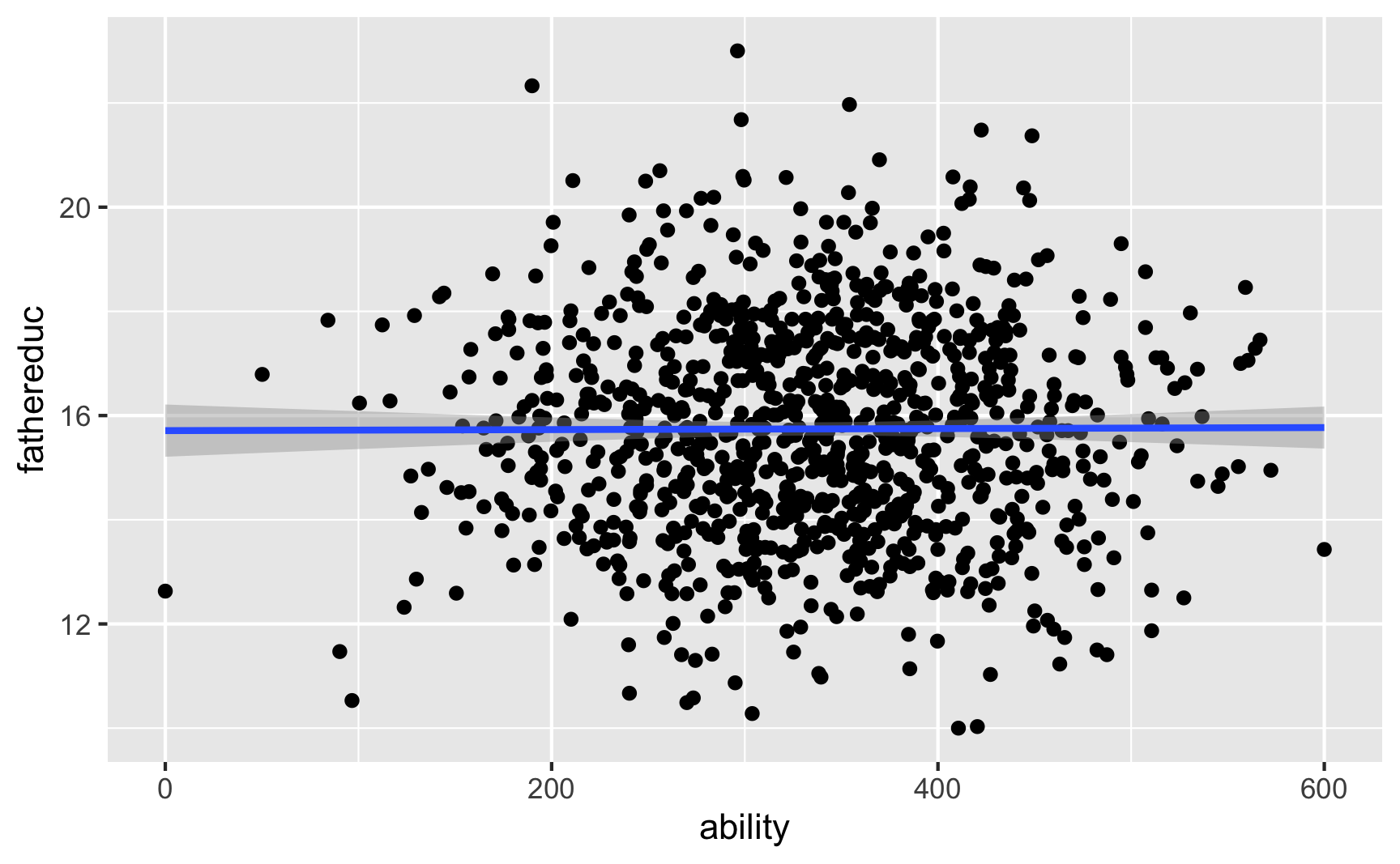
There's not really a test for exogeneity either, since there's no way to measure other endogenous variables in the model (that's the whole reason we're using IVs in the first place!). Because we have the magical `ability` column in this fake data, we can test it. Father's education shouldn't be related to ability:
```{r message=FALSE}
ggplot(ed_fake, aes(x = ability, y = fathereduc)) +
  geom_point() +
  geom_smooth(method = "lm")
```
And it's not! We can safely say that it meets the exogeneity assumption.
In real life, though there's no statistical test for exogeneity. We just have to tell a theory-based story that the number of years of education one's father has is not correlated with anything else in the model (including any omitted variables). Good luck with that---it's probably not a good instrument. This relates to Scott Cunningham's argument that instruments have to be weird. [According to Scott](https://twitter.com/causalinf/status/1194069373935337473):
> The reason I think this is because an instrument doesn’t belong in the structural error term and the structural error term is all the intuitive things that determine your outcome. So it *must* be weird, otherwise it’s probably in the error term.
Let's just pretend that father's education *is* a valid instrument and move on :)
### 2SLS manually
Now we can do two-stage least squares (2SLS) regression and use the instrument to filter out the endogenous part of education. The first stage predicts education based on the instrument (we already ran this model earlier when checking for relevance, but we'll do it again just for fun):
```{r}
first_stage <- lm(educ ~ fathereduc, data = ed_fake)
```
Now we want to add a column of predicted education to our original dataset. The easiest way to do that is with the `predictions()` function from the {marginaleffects} library, which plugs values from a dataset into a model to generate predictions:
```{r}
ed_fake_with_prediction <- predictions(first_stage, ed_fake)
head(ed_fake_with_prediction)
```
Instead of dealing with names like `estimate`, I like to rename the fitted variable to something more understandable after I use `predictions()`:
```{r}
ed_fake_with_prediction <- predictions(first_stage, ed_fake) |>
rename(educ_hat = estimate)
head(ed_fake_with_prediction)
```
We can now use the new `educ_hat` variable in our second stage model:
```{r}
second_stage <- lm(wage ~ educ_hat, data = ed_fake_with_prediction)
model_parameters(second_stage)
```
The estimate for `educ_hat` is arguably more accurate now because we've used the instrument to remove the endogenous part of education and should only have the exogenous part.
### 2SLS in one step
Doing all that two-stage work is neat and it helps with the intuition of instrumental variables, but it's tedious. More importantly, the standard errors for `educ_hat` are wrong and the $R^2$ and other diagnostics for the second stage model are wrong too. You can use fancy math to adjust these things in the second stage, but we're not going to do that. Instead, we'll use a function that does both stages of the 2SLS model at the same time!
There are several functions from different R packages that let you do 2SLS, and they all work a little differently and have different benefits:
- [`iv_robust()` from {estimatr}](https://declaredesign.org/r/estimatr/articles/getting-started.html#iv_robust):
- Syntax: `outcome ~ treatment | instrument`
- Benefits: Handles robust and clustered standard errors; includes special tests for weak instruments (that are better than the standard "check if F > 10")
- [`feols()` from {fixest}](https://raw.githack.com/uo-ec607/lectures/master/08-regression/08-regression.html#Option_3:_fixest::feols()):
- Syntax: `outcome ~ treatment | instrument` or `outcome ~ treatment | fixed effects | instrument` (if using fixed effects)
- Benefits: Handles fixed effects really quickly
- [`ivreg()` from {ivreg}](https://zeileis.github.io/ivreg/):
- Syntax: `outcome ~ treatment | instrument`
- Benefits: Includes special tests for weak instruments (that are better than the standard "check if F > 10")
- [`plm()` from {plm}](https://cran.r-project.org/web/packages/plm/vignettes/plmPackage.html#instrumental-variable-estimators):
- Syntax: `outcome ~ treatment | instrument`
- Benefits: Handles panel data (country/year, state/year, etc.)
[This page here has more detailed examples of the main three](https://raw.githack.com/uo-ec607/lectures/master/08-regression/08-regression.html#Instrumental_variables): `iv_robust()`, `ivreg()`, and `feols()`
I typically like using `iv_robust()`, so we'll do that here. Instead of running a first stage, generating predictions, and running a second stage, we can do it all at once like this:
```{r}
model_2sls <- iv_robust(wage ~ educ | fathereduc,
data = ed_fake)
model_parameters(model_2sls)
```
The coefficient for `educ` here is the same as `educ_hat` from the manual 2SLS model, but here we found it in one line of code! Also, the model's standard errors and diagnostics are all correct now.
### Compare results
We can put all the models side-by-side to compare them:
```{r warning=FALSE}
# gof_omit here will omit goodness-of-fit rows that match any of the text. This
# means 'contains "IC" OR contains "Low" OR contains "Adj" OR contains "p.value"
# OR contains "statistic" OR contains "se_type"'. Basically we're getting rid of
# all the extra diagnostic information at the bottom
modelsummary(list("Forbidden" = model_forbidden, "OLS" = model_naive,
                  "2SLS (by hand)" = second_stage, "2SLS (automatic)" = model_2sls),
             gof_omit = "IC|Log|Adj|p\\.value|statistic|se_type",
             stars = TRUE) |>
  # Add a background color to rows 3-4 and 7-8
  style_tt(i = c(3:4, 7:8), background = "#F5ABEA")
```
Note how the coefficients for `educ_hat` and `educ` in the 2SLS models are close to the coefficient for `educ` in the forbidden model that accounts for ability. That's the magic of instrumental variables!
## Education, wages, and parent's education (multiple instruments) (real data)
This data comes from the `wage2` dataset in the {wooldridge} R package (and it's real!). The data was used in this paper:
> M. Blackburn and D. Neumark (1992), "Unobserved Ability, Efficiency Wages, and Interindustry Wage Differentials," *Quarterly Journal of Economics* 107, 1421-1436. <https://doi.org/10.3386/w3857>
```{.r}
wage2 <- read_csv("data/wage2.csv")
```
```{r include=FALSE}
wage2 <- read_csv(here::here("files", "data", "package_data", "wage2.csv"))
```
This dataset includes a bunch of different variables. If you run `library(wooldridge)` and then run `?wage` you can see the documentation for the data. These are the variables we care about for this example:
| Variable name | Description |
| ------------- | ------------------------------- |
| `wage` | Monthly wage (1980 dollars) |
| `educ` | Years of education |
| `feduc` | Years of education for father |
| `meduc` | Years of education for mother |
To make life easier, we'll rename some of the columns and get rid of rows with missing data:
```{r}
ed_real <- wage2 |>
  rename(education = educ, education_dad = feduc, education_mom = meduc) |>
  na.omit()  # Get rid of rows with missing values
```
### Naive model
We want to again estimate the effect of education on wages, but this time we'll use both one's father's education and one's mother's education as instruments. Here's the naive estimate of the relationship, which suffers from endogeneity:
```{r}
model_naive <- lm(wage ~ education, data = ed_real)
model_parameters(model_naive)
```
This is wrong though! Education is endogenous to unmeasured things in the model (like ability, which lives in the error term). We can isolate the exogenous part of education with an instrument.
### Check instrument validity
Before doing any 2SLS models, we want to check the validity of the instruments. Remember, for an instrument to be valid, it should meet these criteria:
1. **Relevance**: Instrument is correlated with policy variable
2. **Exclusion**: Instrument is correlated with outcome *only through* the policy variable
3. **Exogeneity**: Instrument isn't correlated with anything else in the model (i.e. omitted variables)
**Relevance**
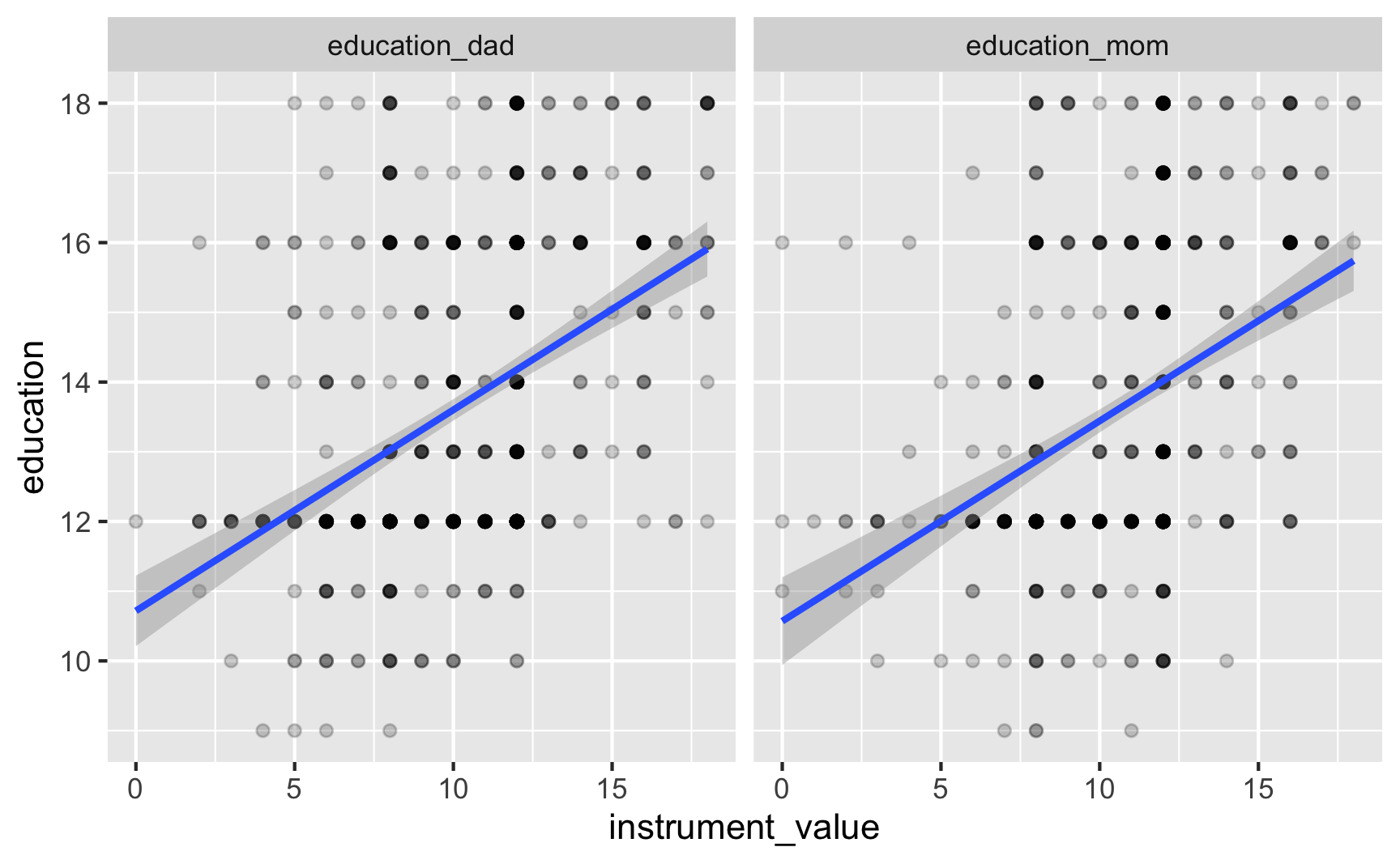
We can check for relevance by looking at the relationship between the instruments and education:
```{r message=FALSE}
# Combine father's and mother's education into one column so we can plot both at the same time
ed_real_long <- ed_real |>
  pivot_longer(cols = c(education_dad, education_mom),
               names_to = "instrument", values_to = "instrument_value")

ggplot(ed_real_long, aes(x = instrument_value, y = education)) +
  # Make points semi-transparent because of overplotting
  geom_point(alpha = 0.2) +
  geom_smooth(method = "lm") +
  facet_wrap(vars(instrument))
```
```{r}
model_check_instruments <- lm(education ~ education_dad + education_mom,
data = ed_real)
model_parameters(model_check_instruments)
modelsummary::get_gof(model_check_instruments)
```
There's a clear relationship between both of the instruments and education, and the coefficients for each are significant. The F-statistic for the model is 83, which is higher than 10, which might be a good sign of a strong instrument. However, it's less than 104, which, [according to this paper](https://arxiv.org/abs/2010.05058), is a better threshold for F statistics. So maybe it's not so relevant in the end. Who knows.
**Exclusion**
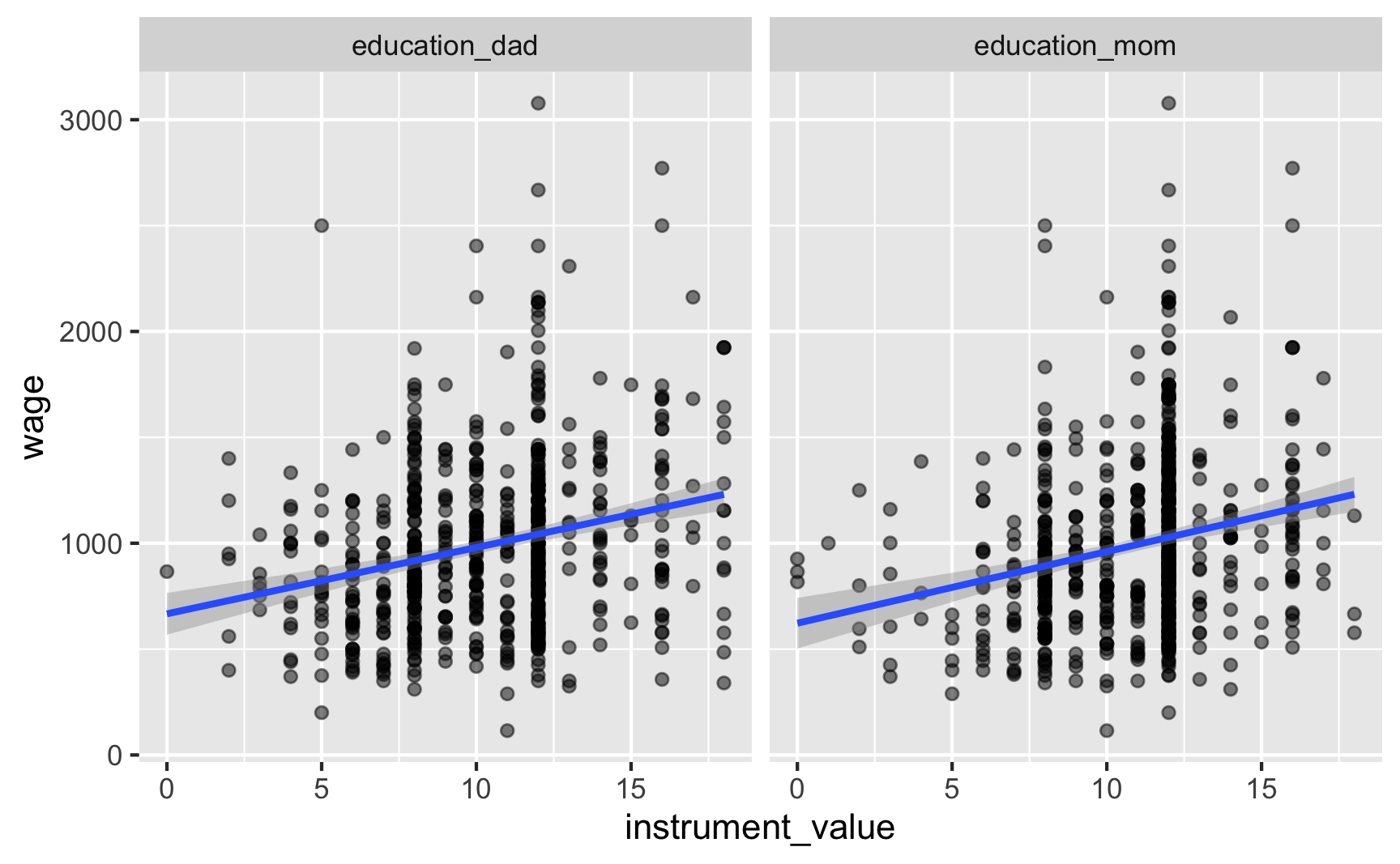
We can check for exclusion in part by looking at the relationship between the instruments and the outcome, or wages. We should see some relationship:
```{r message=FALSE}
ggplot(ed_real_long, aes(x = instrument_value, y = wage)) +
  geom_point(alpha = 0.5) +
  geom_smooth(method = "lm") +
  facet_wrap(~ instrument)
```
And we do! Now we just have to make the case that the only reason there's a relationship is that parental education only influences wages through education. Good luck with that.
**Exogeneity**
The last step is to prove exogeneity---that parental education is not correlated with education or wages. Good luck with that too.
### 2SLS manually
Now that we've maybe found some okay-ish instruments perhaps, we can use them in a two-stage least squares model. I'll show you how to do it by hand, just to help with the intuition, but then we'll do it automatically with `iv_robust()`.
Assuming that parental education is a good instrument, we can use it to remove the endogenous part of education using 2SLS. In the first stage, we predict education using our instruments:
```{r}
first_stage <- lm(education ~ education_dad + education_mom, data = ed_real)
```
We can then extract the predicted education and add it to our main dataset, renaming the `estimate` variable to something more useful along the way:
```{r}
ed_real_with_predicted <- predictions(first_stage, ed_real) |>
  rename(education_hat = estimate)
```
Finally, we can use predicted education to estimate the exogenous effect of education on wages:
```{r}
second_stage <- lm(wage ~ education_hat,
data = ed_real_with_predicted)
model_parameters(second_stage)
```
The coefficient for `education_hat` here should arguably be our actual effect!
### 2SLS in one step
Again, in real life, you won't want to do all that. It's tedious and your standard errors are wrong. Here's how to do it all in one step:
```{r}
model_2sls <- iv_robust(wage ~ education | education_dad + education_mom,
data = ed_real)
model_parameters(model_2sls)
```
The coefficient for `education` is the same that we found in the manual 2SLS process, but now the errors are correct.
### Compare results
Let's compare all the findings and interpret the results!
```{r}
modelsummary(list("OLS" = model_naive, "2SLS (by hand)" = second_stage,
                  "2SLS (automatic)" = model_2sls),
             gof_omit = "IC|Log|Adj|p\\.value|statistic|se_type",
             stars = TRUE) |>
  # Add a background color to rows 3 and 5
  style_tt(i = c(3, 5), background = "#F5ABEA")
```
The 2SLS effect is roughly twice as large and is arguably more accurate, since it has removed the endogeneity from education. An extra year of school leads to an extra \$111.56 dollars a month in income (in 1980 dollars).
### Check for weak instruments
The F-statistic in the first stage was 83.3, which is bigger than 10, but not huge. Again, [this newer paper](https://arxiv.org/abs/2010.05058) argues that relying on 10 as a threshold isn't great. They provide a new, more powerful test called the tF procedure, but nobody's written an R function to do that yet, so we can't use it yet.
We *can*, however, do a couple other tests for instrument strength. First, if you include the `diagnostics = TRUE` argument when running `iv_robust()`, you can get a few extra diagnostic statistics. (See [the "Details" section in the documentation for `iv_robust`](https://www.rdocumentation.org/packages/estimatr/versions/0.26.0/topics/iv_robust#l_details) for more details about what these are.)
Let's re-run the 2SLS model with `iv_robust` with diagnostics on. To see diagnostic details, you can't use `model_parameters()` (since that just shows the coefficients), so you have to use `summary()`:
```{r}
model_2sls <- iv_robust(wage ~ education | education_dad + education_mom,
data = ed_real, diagnostics = TRUE)
summary(model_2sls)
```
The main diagnostic we care about here is the first one: "Weak instruments". This is a slightly fancier version of just looking at the first-stage F statistic. The null hypothesis for this test is that the instruments we have specified are weak, so we'd like to reject that null hypothesis. Here, the p-value is tiny, so we can safely reject the null and say the instruments likely aren't weak. (In general, you want a statistically significant weak instruments test).
Another approach for checking for weak instruments is to calculate something called the Anderson-Rubin confidence set, which is essentially a 95% confidence interval for your coefficient that shows the stability of the coefficient based on how weak or strong the instrument is. This test was invented in like 1949 and it's arguably more robust than checking F statistics, but for whatever reason, *nobody really teaches it or uses it!*. It's not in any of the textbooks for this class, and it's really kind of rare. Even if you google "anderson rubin test weak instruments", you'll only find a bunch of lecture notes from fancy econometrics classes (like [p. 10 here](https://economics.yale.edu/sites/default/files/files/Workshops-Seminars/Econometrics/andrews1-051012.pdf), or [p. 4 here](https://www.ssc.wisc.edu/~xshi/econ715/Lecture_11_WeakIV.pdf), or [p. 4 here](https://ocw.mit.edu/courses/economics/14-384-time-series-analysis-fall-2013/lecture-notes/MIT14_384F13_lec7and8.pdf)).
Most of the automatic 2SLS R packages don't provide an easy way to do this test! But there *is* a package dedicated to IV diagnostics (conveniently named {ivDiag}) that does this test and a ton of others ([see here for a tutorial about all of them](https://yiqingxu.org/packages/ivDiag/articles/iv_tutorial.html#omnibus-function)).
To use it, you need to use `ivDiag()`, which will return a list of a bunch of diagnostics. You have to specify the dataset, the outcome (`Y`), the treatment (`D`), and the instrument(s) (`Z`), and it'll take a few seconds to run because it does some fancy sampling work behind the scenes:
```{r}
#| message: false
#| warning: false
library(ivDiag)

diagnostics <- ivDiag(
  data = ed_real,
  Y = "wage",
  D = "education",
  Z = c("education_dad", "education_mom")
)
```
The `diagnostics` object has a bunch of different slots, like the first stage F-statistic:
```{r}
diagnostics$F_stat
```
Importantly, it has Anderson-Rubin confidence intervals:
```{r}
diagnostics$AR
```
Based on this confidence interval, given the strength (or weakness) of the instruments, the IV estimate could be as low as 76 and as high as 152, which is a fairly big range around the \$112 effect we found. Neat.
There's no magic threshold to look for in these confidence intervals—you're mostly concerned with how much potential variability there is. If you're fine with a causal effect that could be between 76 and 152, great. If you want that range to be narrower, find some better instruments.
## Education, wages, and distance to college (control variables) (real data)
For this last example we'll estimate the effect of education on wages using a different instrument—geographic proximity to colleges. This data comes from David Card's 1995 study where he did the same thing, and it's available in the {wooldridge} library as `card`. You can find a description of all variables [here](http://fmwww.bc.edu/ec-p/data/wooldridge/card.des); we'll use these:
| Variable name | Description |
| ------------- | ----------------------------------------------------- |
| `lwage` | Annual wage (log form) |
| `educ` | Years of education |
| `nearc4` | Living close to college (=1) or far from college (=0) |
| `smsa` | Living in metropolitan area (=1) or not (=0) |
| `exper` | Years of experience |
| `expersq` | Years of experience (squared term) |
| `black` | Black (=1), not black (=0) |
| `south` | Living in the south (=1) or not (=0) |
```{r eval=FALSE}
card <- read_csv("data/card.csv")
```
```{r include=FALSE}
card <- read_csv(here::here("files", "data", "package_data", "card.csv"))
```
Once again, Card wants to estimate the effect of education on wage. But to remove the endogeneity that comes from ability, he uses a different instrumental variable: **proximity to college**.
He also uses control variables to help explain additional variation in wages: `smsa66 + exper + expersq + black + south66`.
**IMPORTANT NOTE**: When you include controls, [every control variable needs to go in *both stages*](https://stats.stackexchange.com/a/177752/3025). The only things from the first stage that don't carry over to the second stage are the instruments—notice how `nearc4` is only in the first stage, since it's the instrument, but it's not in the second stage. The other controls are all in both stages.
He thus estimates a model where:
**First stage:**
$$
\widehat{\text{educ}} = \beta_0 + \beta_1\text{nearc4} + \beta_{2-6}\text{Control variables}
$$
**Second stage:**
$$
\text{lwage} = \beta_0 + \beta_1 \widehat{\text{educ}} + \beta_{2-6}\text{Control variables}
$$
### Check instrument validity
Card provides arguments to support each of three main characteristics of a good instrumental variable:
1. **Relevancy**: People who live close to a 4-year college have easier access to education at a lower costs (no commuting costs and time nor accommodation costs), so they have greater incentives to pursue education.
2. **Exclusion**: Proximity to a college has no effect on your annual income, unless you decide to pursue further education because of the nearby college.
3. **Exogeneity**: Individual ability does not depend on proximity to a college.
Let's see if these assumptions hold up:
**Relevancy**
There should be a strong relationship between the instrument (distance to college) and education:
```{r}
first_stage <- lm(educ ~ nearc4 + smsa66 + exper + expersq + black + south66,
data = card)
model_parameters(first_stage)
modelsummary::get_gof(first_stage)
```
Based on this first stage model, `nearc4` has a significant relationship to `educ`, and the model's joint F statistic is 449, which is definitely bigger than both 10 and 104. Good. We'll call it relevant.
**Exclusion**
For distance to college to work as an instrument and meet the exclusion restriction, we have to prove that distance to college causes wages *only through* getting more education. Think about other possible pathways between living close to a college and increased wages—there could be other paths that don't go through education. Good luck.
**Exogeneity**
For distance to college to work as an exogenous instrument, we have to prove that none of the unobserved confounders between education and earnings are connected to distance. Also good luck.
### 2SLS estimation
Assuming distance to education is a valid instrument (sure), we can use it in a 2SLS model. Remember that control variables have to go in both stages, so specify them accordingly in the model formula:
```{r}
model_2sls <- iv_robust(lwage ~ educ + smsa66 + exper + expersq + black + south66 |
nearc4 + smsa66 + exper + expersq + black + south66,
data = card, diagnostics = TRUE)
model_parameters(model_2sls, digits = 3)
```
Cool cool. Based on the coefficient for `educ`, a year of education *causes* a 15.7% increase in annual wages, on average.
Is that an improvement over a naive model where we don't account for any of the endogeneity?
```{r}
model_naive <- lm(lwage ~ educ + smsa66 + exper + expersq + black + south66,
data = card)
model_parameters(model_naive, digits = 3)
```
Yep! Without removing endogeneity from education, an additional year of education is only associated with a 7.6% increase in annual wages, on average.
### Compare results
For fun, we can look at the results side-by-side:
```{r}
modelsummary(list("Naive OLS" = model_naive, "2SLS" = model_2sls),
             gof_omit = "IC|Log|Adj|p\\.value|statistic|se_type",
             stars = TRUE) |>
  # Add a background color to rows 3-4
  style_tt(i = 3:4, background = "#F5ABEA")
```
### Extra diagnostics
Finally, we can check for weak instruments issues. The F statistic we found in the first stage was pretty big, so that's a good sign, but we can look at the first stage's weak instrument statistic, as well as the Anderson-Rubin confidence interval.
Because we included `diagnostics = TRUE` in the model, we can just use `summary()` to check weak instruments diagnostics:
```{r}
summary(model_2sls)
```
The p-value for the "Weak instruments" test is tiny, which means we can safely reject the null hypothesis that the near college instrument is weak. Neat.
To calculate Anderson-Rubin confidence intervals, we can use `ivDiag()`:
```{r}
#| message: false
#| warning: false
diagnostics_card <- ivDiag(
data = card,
Y = "lwage",
D = "educ",
Z = "nearc4",
controls = c("smsa66", "exper", "expersq", "black", "south66")
)
diagnostics_card$AR
```
Phew. That's a pretty wide interval, ranging from 6% to 31%. It's still positive, but it could sometimes be fairly small.